
Case study · Website
Planning Insights: a website that sells data
Planning Insights is a subscription business that sells access to UK planning application data. We built its website on WordPress, with WooCommerce running the shop, subscriptions and customer accounts, and Elementor for the page layouts.
This page goes through the site in more detail than the overview of our work: what each part is for, how the pages are set up for search, and what you can check for yourself on planninginsights.co.uk.
- What it is
- Public website
- Sector
- UK planning application data (subscription service)
- Built with
- WordPress · WooCommerce · Elementor
- Address
- planninginsights.co.uk
The job the site does
Planning data is a technical product, and the people who might buy it come at it from very different places. A developer hunting for sites, a planning consultant tracking decisions, a supplier looking for projects to quote for and a homeowner keeping an eye on a neighbour’s extension all want something slightly different from the same information.
So the website has three jobs at once. It has to explain the offer in plain terms, it has to turn up for the searches those people actually type, and it has to make subscribing, or asking a question, easy enough that they do it there and then. The service covers the whole of the UK, so the site is organised around what people search for rather than around towns.
What we built
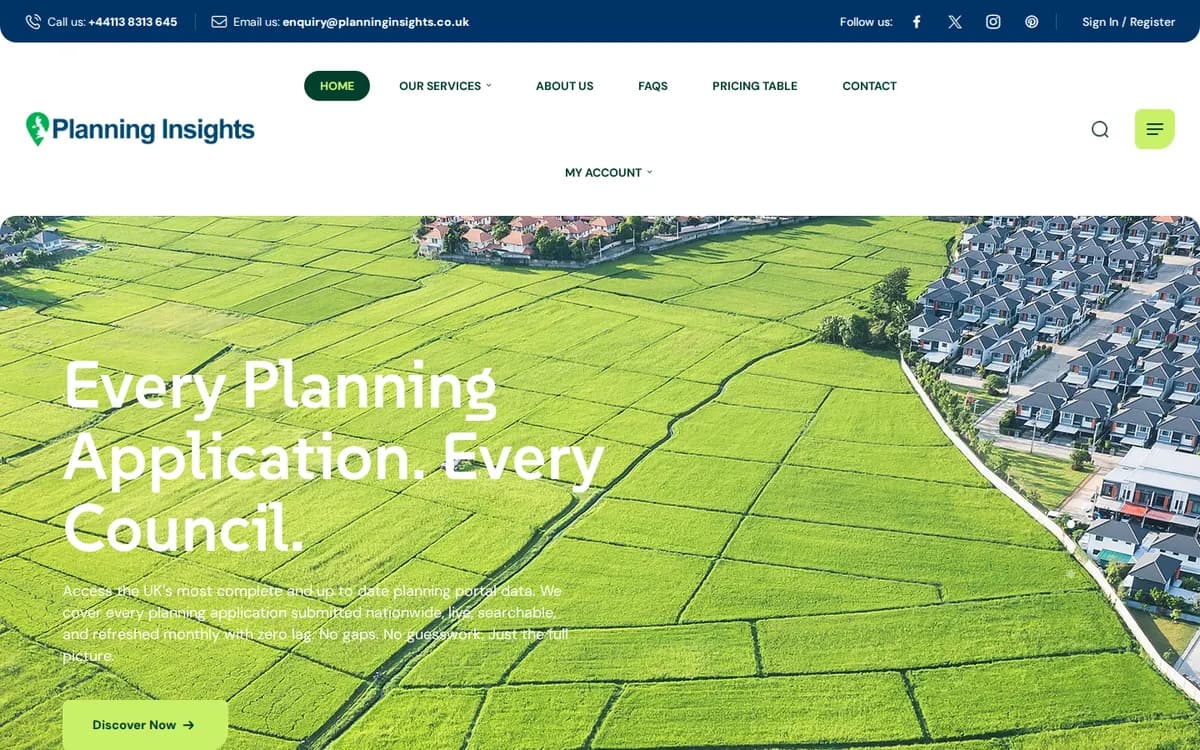
The homepage opens with a hero slider whose rotating messages each lead to a ‘Discover now’ button. Below it, a four-step ‘how it works’ section walks through what happens to the data: it is collected, cleaned and verified, made searchable and filterable, and then used to take action.
A three-tier pricing table sits on the homepage, with a fuller pricing page behind it, so a visitor can compare plans without leaving the page they landed on. When they are ready, WooCommerce takes over: a subscription shop, basket and checkout, plus sign-in, registration and a My Account area for existing customers.
- Three service pages: UK Planning Data, View Planning Applications UK and an Affiliate Program
- Supporting pages for About, Our Services, FAQs and Contact, plus privacy, terms and refunds
- Phone and email in a top bar, both one click away
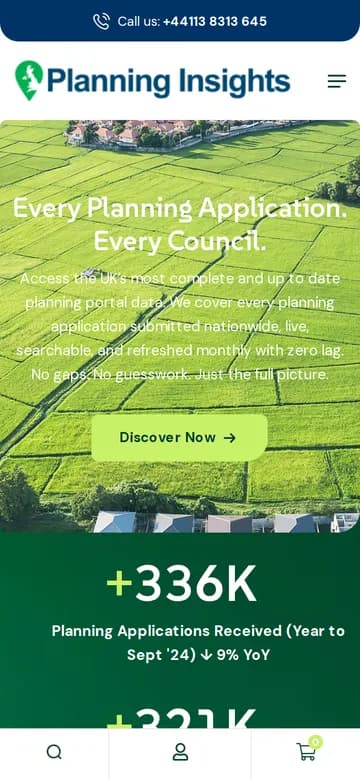
- On a phone, a sticky bar along the bottom of the screen that keeps search, the account area and the basket in reach
- A newsletter sign-up block in the footer
Enquiries that arrive already sorted
Not everyone is ready to subscribe on a first visit, so the homepage carries an enquiry form, repeated further down for anyone who scrolls past the first one. It asks for a name, email address, phone number and message, and it has a required ‘Services you are interested in’ picker.
That one required field does a lot of work. Every enquiry comes in tagged with the service it is about, so whoever answers it knows straight away whether the person is interested in the data itself, in viewing applications or in the affiliate scheme, and can reply with the right information first time.
How it’s built to be found
Each key page has its own title and meta description, written by hand around searches people really make: ‘view planning applications’, ‘planning applications near me’, ‘planning application search’ and ‘UK planning data’. The homepage has a single H1, and the service pages carry visible breadcrumbs.
The View Planning Applications UK page is the long one. It is a landing page built around one search, broken up with sub-headings and lists, with a how-to section and an FAQ block that answer the question properly rather than just pointing at the pricing table.
Underneath the pages you can see, there is an XML sitemap index from Yoast SEO, referenced in robots.txt, and canonical tags throughout. Structured data describes the website and its site search, each page, the organisation and the breadcrumb trail. Open Graph and Twitter tags give shared links a proper card, and a Google Search Console verification tag is in place. The homepage links straight to Contact, UK Planning Data, About, FAQs and Pricing, so the pages that matter most are one click from the front door.
What you can see today
Open planninginsights.co.uk and you can check all of this yourself: the slider and the ‘how it works’ steps, the three service pages, the published pricing table, the sign-in and checkout pages, and the enquiry form with its service picker. View the page source and the titles, descriptions, canonical tags and structured data are there too.
Two things we are careful not to claim. The data platform customers use after signing in is not part of this case study, and the site’s homepage HTML carries no analytics, tag manager or advertising tags, so this is not an ads project. It is a website: a WordPress and WooCommerce build made to explain, to be searched for and to sell.
Call us or get a quote
Talk it through with LDC on the phone, or send a few lines and we’ll come back to you with a quote.
Get a quote
Tell us what you’re trying to achieve.
A few lines is plenty. Tick what you think you need - or “Not sure” - and we’ll reply by email to talk it through and quote.